Education & Empowerment
The postpartum body:
what no one told you
Your body just did one of the most extraordinary things in the universe. Here is what is happening inside it — and how thoughtful movement can support you as you recover and rebuild.
“Your body is not broken. It is in recovery. And recovery, done right, leads to the strongest version of you.”
Pilates & Mommy
Diastasis Recti
The "ab split"
During pregnancy, the growing uterus stretches the connective tissue between the two sides of the rectus abdominis muscle. This is called diastasis recti, and it is very common in late pregnancy and the early postpartum period. Signs can include a "pooch" or doming along the midline, a feeling of core weakness, and lower back discomfort.
How Pilates Helps
Pilates centers on deep core work — especially the transverse abdominis and breath — which research suggests can help restore tension and function across the midline. The goal is coordinated, functional strength, not a guaranteed "closing" of the gap. Persistent or wide separation is worth assessing with a pelvic-health physical therapist.
Pelvic Floor Dysfunction
More than just leaks
The pelvic floor — a hammock of muscles at the base of the pelvis — goes through significant strain during pregnancy and birth. Dysfunction can show up as leaking, pelvic pain, painful intercourse, or a heaviness that may signal prolapse. It can involve weakness, tightness, or coordination problems — which is why symptoms should be assessed individually.
How Pilates Helps
Our classes integrate pelvic floor awareness into movement — teaching both engagement and release, since an overly tight floor can be as problematic as a weak one. This is movement education, not treatment. Pain, prolapse symptoms, or persistent incontinence should be evaluated by an OB-GYN or a pelvic-health physical therapist.
Hormonal Shifts
Your body chemistry changed
Estrogen and progesterone drop sharply after birth, especially while breastfeeding. This can affect mood, joint laxity, and energy. Many mothers are surprised by how different their body feels even months later.
How Pilates Helps
Regular, low-impact movement is broadly associated with better mood and long-term bone and joint health. Pilates is one gentle, accessible way to stay moving through this window — a support, not a cure.
Core Weakness & Back Pain
When your powerhouse feels powerless
Nine months of carrying extra weight, hormonal ligament relaxation, and the demands of newborn care (constant bending, lifting, feeding) leave most postpartum mamas with chronic back pain and a disconnected core.
How Pilates Helps
The Pilates method was literally built around "the powerhouse" — the deep core system. Our postpartum classes rebuild this system layer by layer — thoughtful strength work that may help manage discomfort and improve everyday function.
Body Image & Identity
The fourth trimester is real
Postpartum bodies look and feel different — and our culture doesn't make that easy. Many mothers experience body-image struggles and shifts in identity. Postpartum depression and anxiety are real and common, and can show up physically.
How Pilates Helps
Our studio is a judgment-free space, and movement can be a meaningful part of feeling reconnected to your body. It is not a treatment for depression or anxiety — if you are struggling, please reach out to your provider or a mental-health professional. You deserve real support.
When to Start
Timing matters
The answer isn't the same for everyone. After an uncomplicated birth, some people feel ready to move gently quite soon; a C-section, a complicated birth, or pelvic-floor symptoms usually mean a longer, more individualized return. There is no single universal timeline.
How Pilates Helps
We ask that you get clearance from your OB-GYN or midwife before joining Restore, and we follow their guidance for your situation. Our instructors are trained to modify — but your care provider, who knows your birth and your body, sets the timeline.
Watch & Learn
The science, explained gently
Rebuilding the Foundation
A 4-minute look at what actually happens to the postpartum body — and how thoughtful movement supports recovery.
How Mommy & Me Rebuilds the Core
The 60-second version — why the signature class works from the inside out.
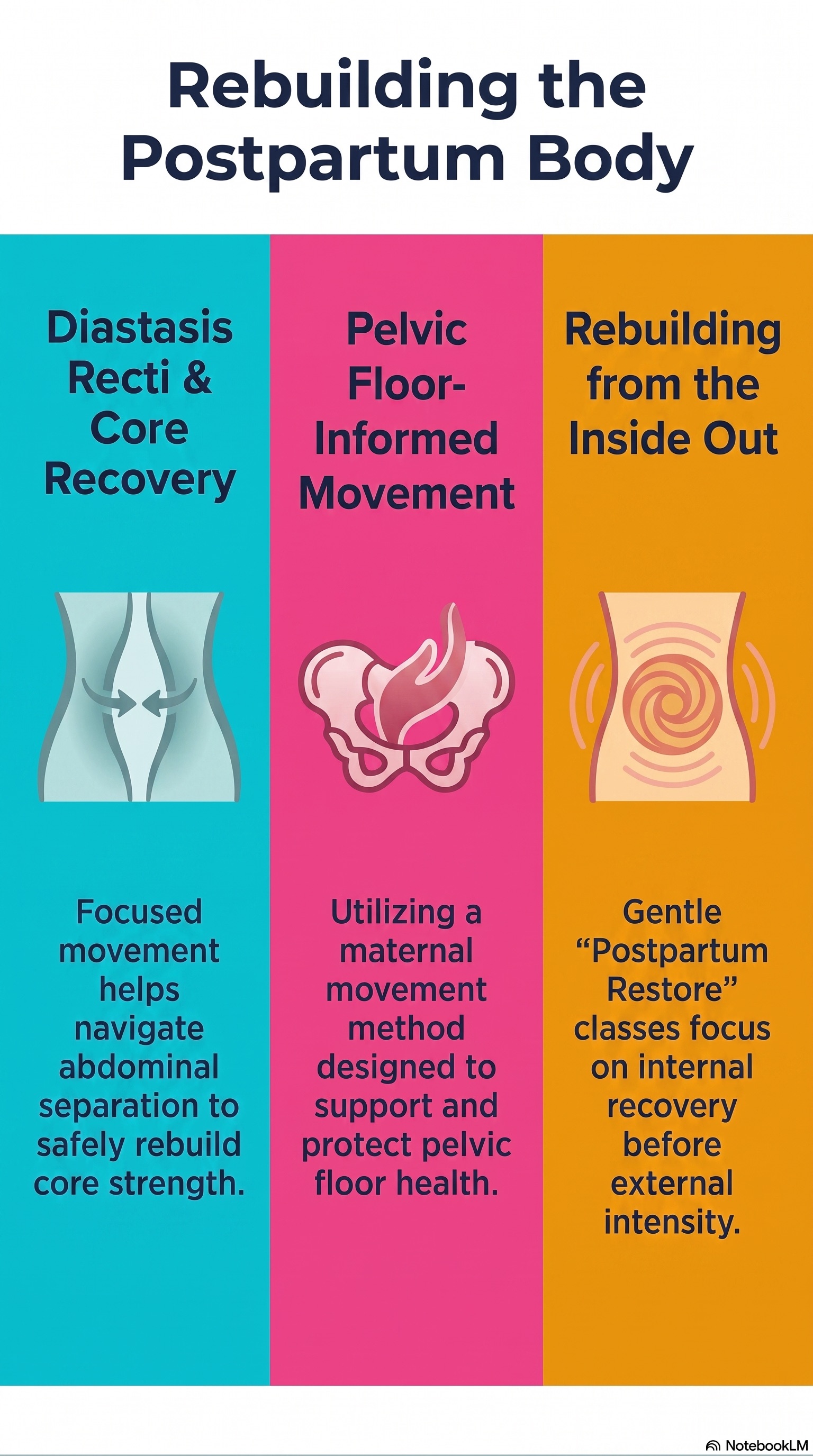
The one-page version
The three ideas this whole page rests on — abdominal separation, the pelvic floor, and rebuilding from the inside out — on a single graphic. Save it, print it, send it to a mama who needs it.
Download & ShareWhat we know · what we’re still learning
This page is education, not medical advice. Pilates & Mommy provides movement instruction — not diagnosis, physical therapy, or rehabilitation. The research on exercise in the postpartum period is genuinely encouraging, and also still evolving; we try to describe it honestly rather than overpromise.
If you have pelvic pain, prolapse symptoms, persistent incontinence, a wide or painful abdominal separation, or any concern about your recovery, please see your OB-GYN, midwife, or a pelvic-health physical therapist. For current guidance on returning to activity after pregnancy, the American College of Obstetricians and Gynecologists (ACOG) is a trustworthy starting point.
Ready to begin your recovery?
Join our Postpartum Restore class and take the first step toward feeling like yourself again.